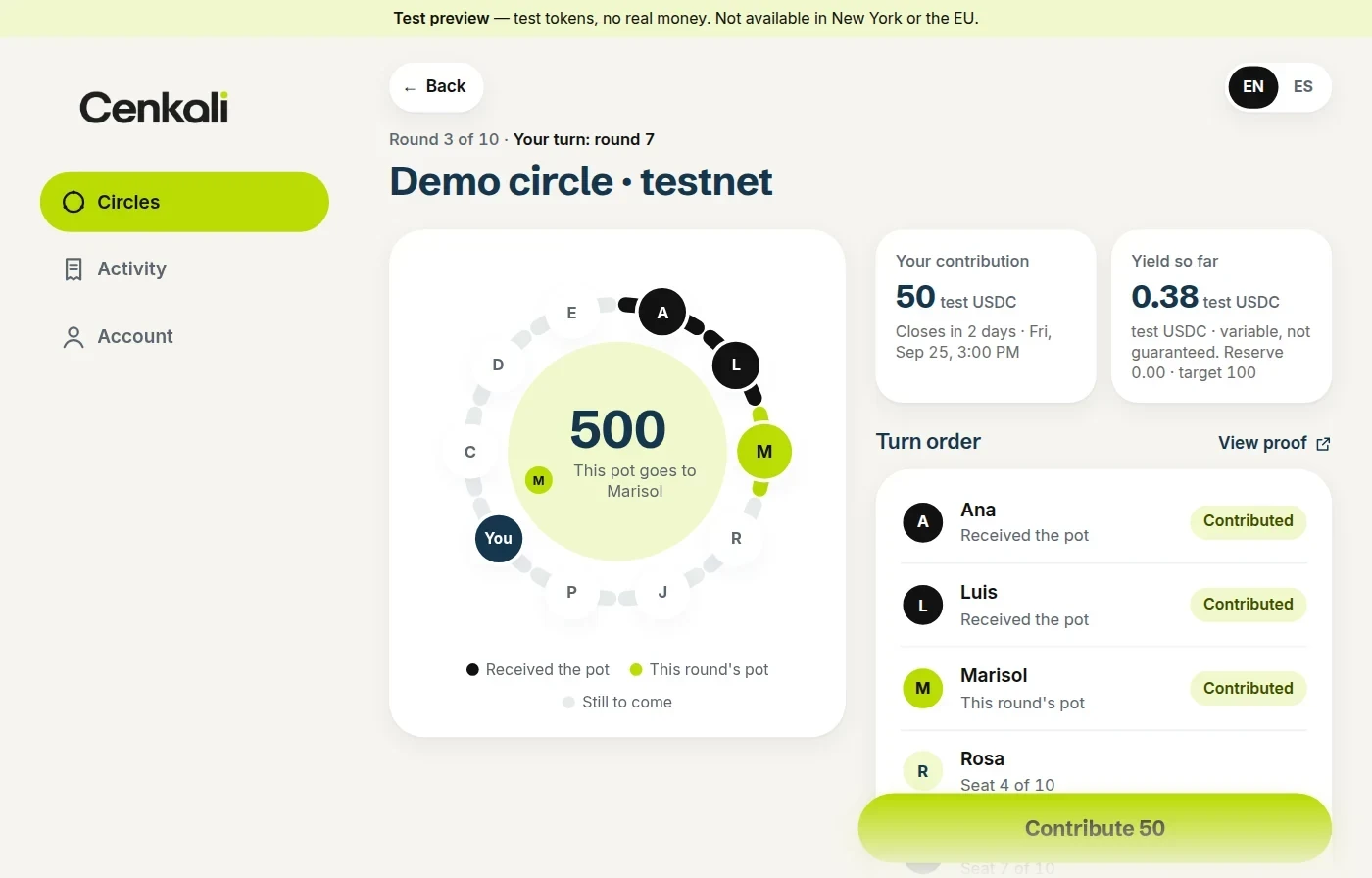
Cenkali turns the tanda into a smart contract on Base. Members contribute USDC, turns rotate automatically, and every payout is visible on-chain — the same rhythm your family already knows, open for anyone to verify.
A tanda is simple: a group of people you trust each put in the same amount, on the same schedule. Each round, one member takes the whole pot. The circle keeps turning until everyone has had their turn. Families and neighbors have run circles like this for generations — long before banks, and often instead of them.
These circles work because of trust. What they've never had is a clear, shared record everyone can check. That's the one thing Cenkali adds.
The circle isn't the old way of saving. For hundreds of millions of people, it's the way that works.
Cenkali doesn't hold or move your money. Public smart contracts execute each step exactly as written — you keep the keys to your own wallet.
Invite people you trust. Together you set the contribution amount, the number of turns, and the schedule. Everyone can see the rules before joining.
Each round, members contribute the same amount in USDC, a U.S. dollar stablecoin issued by Circle. Onboarding uses a Coinbase Smart Wallet, and network fees can be sponsored so members don't juggle gas.
When the round closes, the smart contract sends the pooled pot to whoever's turn it is — on schedule, in the open, with no one deciding by hand.
While USDC waits for the next payout, the protocol supplies it to Aave V3 on Base, a lending protocol. Any interest earned is passed through to the circle. See how the yield works ↓
Yield is variable · not guaranteed · not paid by CenkaliIf someone misses a contribution, a Default Solvency Reserve Pool steps in so the circle keeps turning. The reserve lives inside the smart contract under fixed rules and is funded by the pool's own yield — it isn't a fund that Cenkali holds or controls.
Between turns, the protocol supplies the circle's idle USDC to Aave V3 on Base. Aave is an independent lending protocol, and the interest it generates is passed through to the circle. Historically that rate has ranged 3.5–7% variable APY — but it moves with the market and is never guaranteed.
Cenkali is not a bank and does not pay interest. There is no guaranteed or "risk-free" return, no deposit insurance, and no FDIC coverage. Your share is tied to your participation in the circle, and rates can fall as well as rise.
Cenkali is non-custodial by design. The whole point of moving the circle on-chain is that the rules, the money, and every payout are visible and verifiable — not controlled behind closed doors.
Cenkali doesn't hold, move, or control your money. Smart contracts do exactly what their public code says, and you keep the keys to your own wallet.
Circles use one asset — USDC — to keep things simple and to avoid the risks that come from mixing in volatile collateral tokens.
Contract rules, contributions, and payouts are recorded on Base and can be checked by anyone, any time. Transparency isn't a feature bolted on — it's the foundation.
Before any mainnet launch, the contracts are planned to go through independent security audits and a public bug bounty, with administrative controls renounced or time-locked.
Cenkali is pre-launch and nothing here is an offer to sell a product or financial advice. Using on-chain protocols carries real risk, including smart-contract bugs, loss of access to your wallet, and market volatility. Yield is variable and not guaranteed; there is no bank guarantee, deposit insurance, or FDIC coverage. USDC is issued by Circle; Cenkali is not affiliated with Circle. At launch, Cenkali will not be available to residents of New York or the European Union. This is not legal, tax, or investment advice — please do your own research.
No. Cenkali is not a bank and doesn't offer bank accounts, deposit insurance, or FDIC coverage. It's software that runs savings circles on a public blockchain.
No. Any yield comes from Aave, an independent lending protocol, and is passed through to the circle. It has historically ranged 3.5–7% variable APY on Base, but it changes with the market and can go down. It is never guaranteed and is not "passive income" or a savings account.
No. Cenkali is non-custodial. The protocol doesn't hold, move, or control your funds — public smart contracts execute the circle's rules, and you keep the keys to your own wallet.
Not yet. Cenkali is pre-launch. We're building in the open and testing carefully before real money is ever involved. Join the updates list to hear when circles open.
At launch, Cenkali will not be available to residents of New York or the European Union. We'll expand as the rules in each place become clear.
Through a small, transparent protocol fee: 0.75% of contributions and 15% of the yield the pool generates. There are no hidden charges, and the fees are visible in the contract.
No spam, no pressure — just an update when there's something real to try.